Donroe Doctrine
1. Introduction
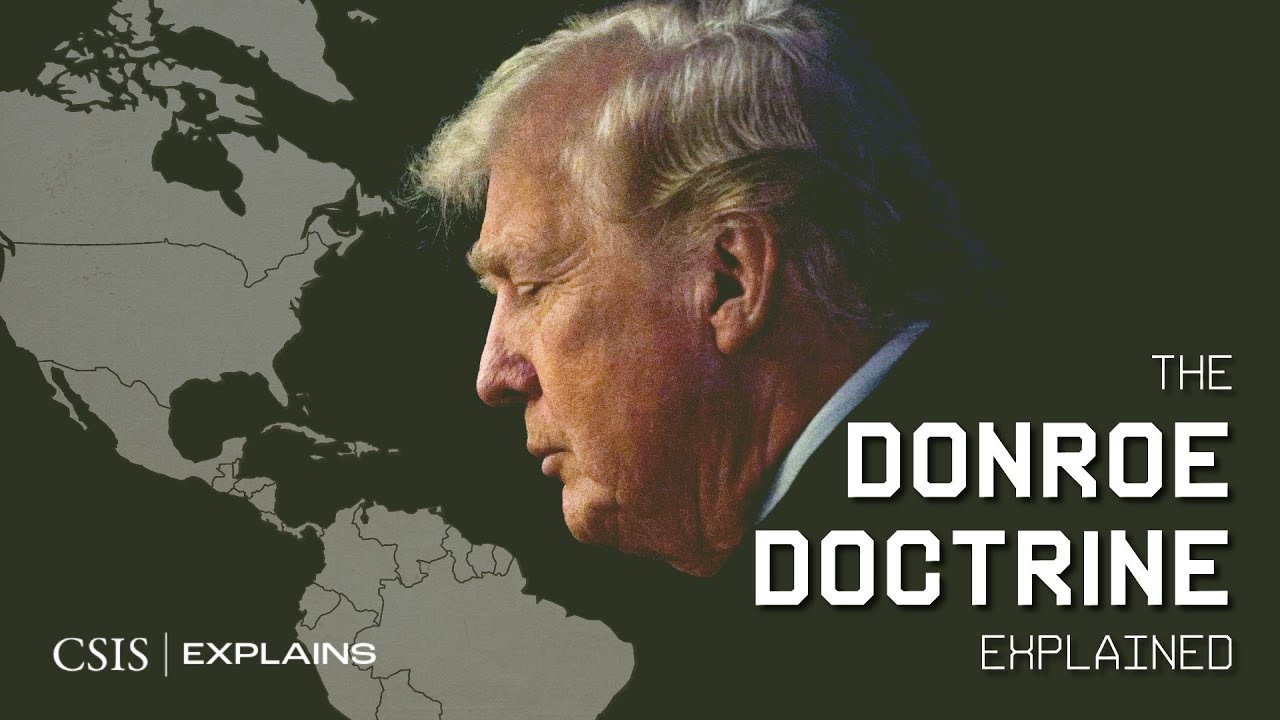
The Donroe Doctrine presents itself as a strategic reassertion of United States authority in the Western Hemisphere, framed as a necessary response to renewed great-power competition and regional insecurity. Publicly articulated during the second Trump administration, the Donroe Doctrine is described as a modern adaptation of the Monroe Doctrine, updated to confront contemporary threats, such as external geopolitical influence, transnational crime, irregular migration, and strategic economic penetration by rival powers. Its declared objective is to restore American primacy in the hemisphere by preventing extra-regional actors from acquiring decisive political, military, or economic leverage in Latin America and the Caribbean.
At the level of official narrative, the Donroe Doctrine claims continuity with a long-standing U.S. tradition of hemispheric responsibility. It portrays itself as defensive rather than expansionist, protective rather than imperial. The doctrine asserts that instability in the Americas directly threatens U.S. national security and that external actors exploiting weak governance or political fragmentation justify a firmer American posture. Under this logic, hemispheric dominance is not framed as optional power projection but as a structural necessity imposed by geography, security interdependence, and historical precedent.
This framing, however, obscures the doctrine’s deeper conceptual shift. The Donroe Doctrine does not merely restate a policy preference for influence; it advances a claim of managerial authority over the political and strategic orientation of an entire region. Unlike the original Monroe Doctrine, which functioned as a diplomatic warning to European empires, the Donroe Doctrine asserts an operational mandate to shape outcomes within sovereign states. The language of “reassertion” and “enforcement” embedded in the doctrine signals a move away from persuasion and partnership toward conditionality, coercion, and, in extreme cases, unilateral action.
The doctrine’s self-presentation relies heavily on the vocabulary of order. It claims to defend stability, democracy, and security against malign interference. Yet the order it envisions is not horizontal but hierarchical. The Western Hemisphere is implicitly constructed as a security domain under U.S. supervision, where sovereignty is tolerated only insofar as it aligns with American strategic priorities. States are not treated as equal participants in a shared regional system but as variables to be stabilised, corrected, or contained.
This distinction is critical. The Donroe Doctrine does not arise from multilateral agreement, regional consent, or treaty-based authority. It is asserted unilaterally as a function of power. Its legitimacy is grounded not in law but in capability and intent. The doctrine therefore operates outside the architecture of post-1945 international law, which rests on sovereign equality, non-intervention, and the prohibition of the use of force except in narrowly defined circumstances. By claiming a standing right to exclude rivals and to intervene against perceived threats, the Donroe Doctrine challenges these foundational constraints.
Supporters of the doctrine argue that legal formalism is inadequate in an era of hybrid threats and strategic competition. They contend that rivals exploit legal restraint while pursuing influence through investment, technology, and political leverage. From this viewpoint, hemispheric primacy is presented as a corrective to naïveté. Yet this justification assumes what it seeks to prove: that strategic rivalry authorises the suspension of legal limits. The doctrine thus converts geopolitical anxiety into normative permission, collapsing the distinction between threat perception and lawful response.
The Donroe Doctrine also claims to be pragmatic. It promises decisive action where previous administrations relied on diplomacy, institutions, or gradual engagement. This promise of effectiveness is central to its appeal. However, effectiveness is defined narrowly as immediate control or exclusion, not as durable stability or legitimate order. The doctrine’s emphasis on short-term enforcement raises a fundamental question: whether power exercised without legal anchoring can produce sustainable security in a region shaped by the historical memory of intervention and domination.
This article advances a critical assessment of the Donroe Doctrine on doctrinal, legal, and geopolitical grounds. It argues that the doctrine is best understood not as a defensive update to an old policy, but as a reversion to sphere-of-influence thinking incompatible with contemporary international law and counterproductive to long-term regional stability. The analysis proceeds by examining the doctrine’s conceptual lineage, its operational claims, and its practical consequences, demonstrating that what the Donroe Doctrine claims to protect—order, security, and influence—it ultimately undermines.
2. From Monroe to “Trump Corollary”: Continuity and Rupture
2.1 The original Monroe Doctrine as a strategic-legal narrative
The original Monroe Doctrine was never a rule of international law, nor did it claim to create enforceable legal obligations. It functioned as a geopolitical warning issued by a comparatively weak state seeking to deter renewed European colonial expansion in the Americas. Announced by James Monroe in 1823, the doctrine declared that further European intervention in the Western Hemisphere would be viewed as a hostile act against the United States. Its force rested entirely on political signaling and anticipated power alignment, not on treaty law, consent, or institutional authority.
Crucially, the Monroe Doctrine did not assert a right to intervene within the Americas. It articulated a negative claim—exclusion of external empires—rather than a positive claim of governance or supervision. The doctrine neither created a legal regime nor purported to override the sovereignty of newly independent Latin American states. Its language was deliberately ambiguous, allowing it to operate as a strategic posture rather than a binding commitment. In doctrinal terms, it was an exercise in strategic narration, not jurisdictional assertion.
Over time, however, U.S. practice transformed this narrative into policy leverage. As American power expanded in the late nineteenth and early twentieth centuries, the Monroe Doctrine was gradually reinterpreted as justification for increasingly intrusive conduct. What began as a diplomatic warning evolved into a rhetorical instrument used to frame U.S. preferences as a hemispheric necessity. This evolution was not the result of legal development but of power accretion. The doctrine’s persistence reflects not normative authority but the capacity of a dominant state to convert historical language into contemporary justification.
2.2 The Roosevelt Corollary as the closest historical analogue
The most significant mutation of the Monroe Doctrine occurred under Theodore Roosevelt, whose corollary marked a decisive conceptual shift. The Roosevelt Corollary reframed the doctrine from a principle of external exclusion to a rationale for internal intervention. The United States now claimed the right to act as a hemispheric enforcer when states were deemed incapable of maintaining order or meeting international obligations.
This move altered the doctrine’s structure. The corollary replaced deterrence with administration and warning with policing. Latin American states were no longer merely protected from European intervention; they were subjected to conditional sovereignty, assessed according to standards defined in Washington. The corollary thus asserted a unilateral right to intervene preemptively, transforming the Monroe Doctrine into a doctrine of supervision.
Latin American legal tradition has consistently rejected this move as illegitimate. It directly contradicts principles developed in the region to resist external domination, particularly doctrines emphasizing sovereign equality and non-intervention. The Roosevelt Corollary is remembered not as a stabilising innovation but as a legal rupture that enabled occupations, regime manipulation, and economic coercion. Its legacy is inseparable from the erosion of trust between the United States and Latin America and from the region’s insistence that no state may claim guardianship over another’s internal order.
The relevance of the Roosevelt Corollary lies in its function as precedent. It demonstrates how a doctrine initially framed as defensive can be converted into an expansive mandate once power asymmetries allow reinterpretation. This historical lesson is central to understanding contemporary concerns surrounding the Donroe Doctrine.
2.3 What is new in the Donroe Doctrine
The Donroe Doctrine represents a further escalation rather than a simple revival. Unlike earlier phases, it does not rely on episodic interventions justified by discrete crises. It declares hemispheric primacy as a standing strategic priority, explicitly committing the United States to deny non-hemispheric actors the ability to deploy forces or control assets deemed strategically vital. This language is categorical rather than situational. It does not ask whether a specific intervention is necessary; it assumes continuous entitlement to exclusion.
This shift is structural. The doctrine treats geopolitical competition itself as a sufficient basis for action. Influence by rival powers is framed as a security threat irrespective of host-state consent or legality. Economic presence, infrastructure investment, and diplomatic alignment are reclassified as strategic risks, collapsing the distinction between political competition and military danger. The result is a doctrine that normalises permanent vigilance and anticipatory constraint.
The Donroe Doctrine also differs in its integrated toolkit. Military posture remains central, but it is complemented by coercive economic instruments such as tariffs, trade conditionality, and reciprocal access measures. Security narratives around migration and organised crime are incorporated to extend jurisdictional reach and to frame domestic political concerns as hemispheric security imperatives. These tools are not treated as exceptional measures but as routine mechanisms of enforcement.
What emerges is a doctrine that blends strategic exclusion, economic pressure, and security framing into a single architecture of control. Unlike the Monroe Doctrine’s original warning or even the Roosevelt Corollary’s episodic interventions, the Donroe Doctrine aspires to continuous management of the hemisphere. Its novelty lies not in its rhetoric but in its ambition: a permanent claim to shape the strategic environment of an entire region without legal delegation or multilateral constraint.
This transformation marks a clear rupture. The Donroe Doctrine is no longer a doctrine about keeping others out. It is a doctrine about deciding who may act, invest, govern, or align within the Western Hemisphere. That claim, more than any historical analogy, defines its significance and explains the depth of the legal and geopolitical controversy it provokes.
3. The Doctrine as State Policy
3.1 The 2025 National Security Strategy’s operative commitments
The Donroe Doctrine becomes state policy not through abstract rhetoric but through the operative verbs embedded in the 2025 National Security Strategy. These verbs—reassert, enforce, deny, discourage collaboration with others, and enlist and expand—are not stylistic choices. They define the doctrine’s architecture of authority.
Reassert presupposes a prior entitlement that has lapsed. It frames hemispheric primacy as something inherently American, temporarily neglected rather than politically contested. Enforce goes further. Enforcement implies a rule-maker with standing authority and an enforcement deficit that must be corrected. In international law, enforcement is either collective or consent-based. Here, it is unilateral. The verb thus signals a claim to supervisory power without legal delegation.
Deny introduces a logic of exclusion. It treats the presence of non-hemispheric actors as a condition to be prevented rather than a choice made by sovereign states. This move reframes Latin American foreign policy autonomy as a vulnerability to be managed. Discourage collaboration with others to complete the hierarchy. Collaboration by regional states is no longer neutral diplomacy; it becomes suspect alignment requiring correction.
The paired formulation Enlist and Expand reveals the doctrine’s internal contradiction. Enlist suggests partnership, yet it is embedded within a framework of enforcement and denial. Participation is invited only within parameters defined by Washington. Expand signals scale and permanence. The doctrine is not crisis-bound; it is designed to grow in scope, capacity, and reach.
These verbs matter because they establish a vertical relationship. They encode hierarchy as policy. States are positioned as partners only after acceptance of U.S. primacy. The National Security Strategy does not describe a cooperative regional order; it outlines an administrative one, where compliance precedes inclusion.
3.2 Executive signalling: “Our Hemisphere” as a claim of entitlement
Official messaging reinforces this hierarchy through language that converts geography into entitlement. Statements asserting that the Western Hemisphere is “our hemisphere” function as more than political shorthand. They imply custodianship. In diplomatic terms, such framing recasts sovereign equals as occupants of a managed space.
When Marco Rubio declared that the Western Hemisphere belongs to the United States’ security domain, the statement was not interpreted regionally as reassurance. It was read as a downgrade of sovereignty. The possessive formulation signals ownership rather than responsibility, authority rather than cooperation.
This matters in Latin America, where historical experience has trained political elites and legal institutions to treat language as a policy signal. Claims of hemispheric ownership evoke earlier periods when similar language preceded intervention, occupation, or economic subordination. Even when followed by assurances of partnership, the initial framing dominates interpretation.
The problem is not tone; it is structure. “Our hemisphere” collapses the distinction between influence and control. It implies that external relationships, investments, or security arrangements require American acquiescence. For regional audiences, this confirms that the Donroe Doctrine does not merely prioritise U.S. interests but conditions the legitimacy of others’ choices.
As a result, executive signalling undermines the doctrine’s own stated goal of cooperation. It activates legal and political reflexes rooted in non-intervention doctrine and encourages hedging behaviour. What is presented domestically as clarity is received regionally as subordination.
3.3 Institutionalisation risk
Doctrines endure not because they are persuasive but because they become embedded. The Donroe Doctrine carries a high risk of institutionalisation that outlasts both its original political context and any specific triggering crisis.
Once adopted, doctrines reshape bureaucratic incentives. Defence planning incorporates hemispheric denial scenarios. Procurement prioritises assets justified by persistent regional presence. Basing arrangements, rotational deployments, and intelligence architectures are designed around continuous primacy rather than episodic engagement. Each adjustment creates sunk costs that generate momentum.
Sanctions regimes further entrench doctrine. Once coercive economic tools are normalised as instruments of hemispheric management, they develop internal constituencies and routines. Reversal becomes politically and administratively costly, even when strategic conditions change.
Partner conditionality deepens the lock-in effect. Security cooperation, trade access, and development assistance become contingent on alignment with the doctrine’s exclusionary logic. Over time, this converts discretionary policy into structural dependency, reducing flexibility on both sides.
The result is a self-fulfilling order. The more the Donroe Doctrine is operationalised, the more necessary it appears. Alternatives are crowded out not by argument but by infrastructure. What began as a strategic choice hardens into an assumed baseline.
This institutionalisation risk is central to the doctrine’s danger. It transforms a contested vision of hemispheric control into administrative normality. Once embedded, the doctrine no longer requires constant justification. It persists through routines, budgets, and compliance mechanisms, making reversal difficult even when its costs become evident.
At that point, the Donroe Doctrine ceases to be a policy debate. It becomes an operating system for U.S. action in the hemisphere—one that privileges hierarchy, marginalises law, and constrains the political autonomy of an entire region.
4. Doctrinal Stress Test: The Donroe Doctrine Against Core Legal Constraints
4.1 Sovereignty and non-intervention as the regional baseline
In the inter-American system, sovereignty and non-intervention are not decorative principles. They operate as a regional baseline for legitimacy. Latin American international legal tradition emerged under persistent conditions of external pressure and intervention. As a result, non-intervention is treated as a constitutional rule of regional order: it protects political independence, guards against coercive diplomacy, and rejects claims that powerful states may “manage” weaker ones for security or civilisation.
The Donroe Doctrine’s narrative of hemispheric primacy collides with this baseline immediately. A doctrine that presents the region as a U.S. security domain implies that sovereignty is conditional—valid when aligned, suspect when autonomous. “Hemispheric guardianship” language signals hierarchy: the guardian judges, the protected obeys. That structure triggers legitimacy resistance because it reverses the premise of sovereign equality. The resistance is not ideological; it is institutional and doctrinal. Once a doctrine is heard as a claim of tutelage, it activates legal reflexes built to prevent exactly that outcome.
This is why the Donroe Doctrine produces predictable reputational costs. Even governments that privately desire U.S. support will resist rhetoric that downgrades sovereignty publicly. Regional legitimacy is not merely about outcomes; it is about the status conferred by the rules. Any doctrine that implies managed sovereignty invites legal contestation, diplomatic hedging, and symbolic opposition because accepting the doctrine’s premise concedes inferior standing.
4.2 Use of force and “enforcement” language
The Donroe Doctrine’s most legally consequential feature is not its concern about rival powers; it is its enforcement posture. International law draws sharp distinctions between permissible and impermissible force. Four categories matter.
-
Lawful collective security: coercive measures authorised through collective mechanisms designed to protect international peace and security. This is the closest thing international law recognises as “enforcement” in a strict sense, because authority is delegated by a collective decision structure rather than asserted unilaterally.
-
Self-defence: force used in response to an armed attack (and, in contested interpretations, an imminent one), subject to necessity and proportionality. Self-defence is not a licence for geopolitical management; it is a narrow exception tied to a concrete threat threshold.
-
Consent-based operations: uses of force on the territory of another state pursuant to that state’s valid consent. Consent can legalise presence, training, assistance, and even kinetic action against non-state actors, but it does not legalise coercion against the consenting state’s political choices. Consent is revocable and cannot be presumed.
-
Unilateral enforcement of a sphere: force or coercion justified by a claim of regional entitlement—excluding rivals, controlling assets, punishing alignment, or shaping regimes. This category has no stable legal basis. It is the logic of domination, not the logic of law.
The analytical problem is direct: when a national strategy uses verbs such as “reassert” and “enforce” in a hemispheric register, it encourages a posture that can slide into anticipatory or preventive rationales. “Enforcement” language is structurally permissive. It frames force as the execution of a standing mandate rather than a response to a discrete legal trigger. Once that framing is accepted, the pressure to identify “imminent” threats increases, definitions of threat expand, and exceptionalism becomes routine.
This is how a doctrine becomes legally corrosive. It does not need to declare a rejection of the rules. It only needs to build an operational vocabulary that treats the rules as secondary to a strategic entitlement.
4.3 “Denying” rivals and controlling “strategically vital assets”
The Donroe Doctrine’s commitment to “deny” non-hemispheric competitors the ability to position forces or control strategically vital assets introduces a core legal ambiguity: great-power competition is not a legal ground for coercion. Rivalry may be politically salient, but international law does not permit force or coercion merely to prevent another state from gaining influence through diplomacy, trade, or investment.
This matters because the doctrine collapses several distinct phenomena into a single security category:
-
Foreign investment becomes framed as a strategic encroachment.
-
Port access or infrastructure projects become framed as latent basing.
-
Technology and telecom deals become framed as intelligence capture.
-
Diplomatic alignment becomes framed as hostile positioning.
Some of these concerns may be strategically rational. None of them automatically satisfies a lawful threshold for coercive interference in another state’s external relations. If the “denial” logic is operationalised through pressure campaigns, sanctions designed to dictate third-party relations, or threats tied to investment choices, the doctrine begins to normalise unlawful forms of compulsion.
The risk is not theoretical. Treating infrastructure access as a casus belli logic—even implicitly—pushes international practice toward a world where economic activity is securitised and coercion is justified as “prevention.” That outcome encourages other powers to adopt symmetrical doctrines in their regions, each claiming the right to deny “strategic assets” to rivals. The legal order becomes an arena of competing exclusion zones, not a system of general rules.
A critical point follows: the Donroe Doctrine’s “asset control” language sounds technical, but its legal effect is expansive. It turns normal sovereign choices—who to trade with, who to borrow from, who to contract with—into objects of external policing.
4.4 The doctrine’s implicit theory of jurisdiction
The Donroe Doctrine is also an attempt to expand practical jurisdiction under the cover of security necessity. Its logic rests on an implicit claim: because the United States experiences downstream harms (drugs, irregular migration, organised crime), it may treat upstream conditions across the hemisphere as part of its own security jurisdiction.
This is not a trivial move. It reshapes jurisdiction in three steps:
-
Reclassify domestic harms as hemispheric threats: migration and narcotics are framed as strategic attacks on the state, not governance problems requiring cooperation.
-
Treat governance deficits abroad as permission: when partner states are portrayed as “unable” to control cartels or borders, the doctrine invites claims that action may proceed without full consent or with diluted consent standards.
-
Convert border security into regional security management: enforcement becomes outward-facing. The border becomes the justification for projecting control far beyond the border.
The doctrinal weakness is that international law does not grant a general right to extend security jurisdiction across other sovereign territories because transnational problems exist. Jurisdiction is not a gradient that expands with frustration. It remains bounded by sovereignty, consent, and the strict conditions governing force and coercion.
This is where cartel and migration framing become legally dangerous. If organised crime is treated as a standing reason for external action, then “security” becomes a universal solvent. Every state can claim exceptional jurisdiction for internal harms with external links. The rule becomes: severe problem equals permission. That is not law; it is discretionary power.
A legally serious hemispheric strategy against cartels and irregular migration must therefore be built on the opposite premise: cooperation, consent, shared institutions, and clearly limited mandates. The Donroe Doctrine’s implicit jurisdictional theory does the reverse. It treats transnational disorder as justification for hierarchical control and presents that control as necessity rather than choice.
The Donroe Doctrine fails the stress test because it embeds hierarchy into the language of security. It treats sovereign equality as negotiable, reframes rivalry as legal trigger, and pushes enforcement logic into areas where international law is designed to impose restraint.
5. Case Study: Venezuela 2026 as the Doctrine’s Proof-of-Concept
5.1 Why the Venezuela operation became the doctrine’s showcase
The 2026 operation against Venezuela became the Donroe Doctrine’s proof-of-concept because it translated abstract claims of hemispheric primacy into a visible act of enforcement. The capture of Nicolás Maduro produced immediate global shock not simply because of its operational audacity, but because of what it signaled doctrinally: a willingness to remove a sitting head of government in the Western Hemisphere through unilateral action justified by strategic entitlement rather than collective authority.
Expert analysis converged on one point. This was not perceived as an isolated counter-narcotics or law-enforcement operation. It was read as the practical application of the “Trump Corollary” logic: the United States asserting its right to decide when a hemispheric government has forfeited legitimacy and to act on that judgment directly. The operation was framed domestically as evidence that American dominance had been “restored,” reinforcing the doctrine’s narrative that previous restraint had been weakness rather than legality.
The Venezuela case also served a symbolic function. It demonstrated that the Donroe Doctrine was not aspirational. It showed that exclusion of rivals, regime disruption, and transitional management could be pursued without multilateral authorisation. For a doctrine built around reassertion and enforcement, Venezuela provided the concrete example required to convert strategy into precedent.
5.2 Regional and international reactions as legality signals
The immediate regional and international reaction functioned as a legality signal. Joint condemnations by Latin American and European governments did not hinge on sympathy for the Maduro regime. They focused on the method. Statements emphasised sovereignty, non-intervention, and the destabilising implications of normalising unilateral regime removal.
This distinction matters. When states with diverse ideological positions converge on condemnation, it reflects not political alignment but shared concern over precedent. The Venezuela operation was widely perceived as illegitimate, not because of its target, but because it asserted a right to enforce political outcomes across borders. That perception triggered defensive legal language rooted in regional memory of intervention.
International reactions followed a similar pattern. The operation was treated as a breach of the post-1945 settlement rather than an isolated excess. Observers stressed that if a major power can justify such action through hemispheric doctrine, the constraint against force becomes conditional on geography and power. This reading explains why condemnation was swift and categorical. The fear was not Venezuelan instability alone, but the erosion of a general rule.
5.3 Strategic second-order effects
Beyond the immediate political impact, the Venezuela case generated predictable second-order effects that undercut the Donroe Doctrine’s stated objectives.
First, regime instability risks multiplied rather than diminished. Removing a leader through external force does not resolve underlying political fragmentation. It creates power vacuums, factional competition, and legitimacy deficits that require sustained external management. The doctrine offers no credible legal or institutional framework for long-term governance, increasing the probability of prolonged instability rather than orderly transition.
Second, the operation incentivised rival powers to harden asymmetric presence rather than withdraw. When influence becomes criminalised or securitised, it moves underground. Intelligence cooperation, economic diversification, and covert political support become more attractive than overt engagement. The doctrine’s exclusionary logic therefore risks entrenching the very rival presence it seeks to eliminate.
Third, reputational costs directly undermined the doctrine’s “enlist” objectives. Cooperation on migration control, cartel suppression, and security coordination depends on trust and consent. The Venezuela operation signaled that the partnership operates under the threat of coercion. States facing domestic legitimacy constraints are less willing to align publicly with a power perceived as willing to override sovereignty. The result is quieter cooperation at best and strategic hedging at worst.
The Venezuela case thus exposes the Donroe Doctrine’s central weakness. As a demonstration of power, it succeeded. As a foundation for durable hemispheric order, it revealed the doctrine’s structural limits. Enforcement produced compliance signals, not legitimacy. The costs emerged not immediately, but systemically—through resistance, recalibration, and the slow erosion of cooperative capacity.
6. Geopolitical Logic: What the Donroe Doctrine Is Trying to Achieve
6.1 Great-power exclusion in the near abroad
The Donroe Doctrine is designed to exclude rival power presence in the Western Hemisphere by treating external influence as a security condition to be prevented, not a diplomatic reality to be managed. Its target is not a single state; it is a set of influence channels that allow China, Russia, and Iran to operate below the threshold of overt military confrontation while still shaping regional decisions.
The influence channels are identifiable and largely non-military:
-
Finance and sovereign leverage: credit lines, development financing, debt restructuring, and commodity-backed arrangements that create long-term dependence and policy leverage.
-
Ports, logistics, and dual-use infrastructure: commercial port concessions, logistics corridors, and transport nodes that can support surveillance, access, or coercive economic pressure without basing troops.
-
Telecom and digital infrastructure: 4G/5G equipment, cloud and data services, undersea cable landing points, and surveillance-capable systems that give long-term intelligence advantages and political leverage.
-
Energy and extractives: oil-for-cash arrangements, upstream/downstream energy investments, and critical mineral projects that tie domestic elites and fiscal stability to external partners.
-
Intelligence networks and proxy connectivity: covert facilitation, diaspora-linked fundraising, illicit networks, and security cooperation that strengthen asymmetric presence without conventional deployment.
The Donroe Doctrine operationalises exclusion through pressure campaigns that aim to break these channels: pushing governments to expel suspected foreign intelligence activity; encouraging terrorist designations of proxy-linked entities; warning against infrastructure deals framed as security threats; and leveraging bilateral trade, financing, or security cooperation as inducement and penalty.
The critical point is doctrinal: the doctrine treats the hemisphere as a managed denial environment. That is a sphere-of-influence posture. It does not simply compete for influence; it asserts a right to decide which external ties are permissible. The strategy is also vulnerable to overreach because most rival influence is embedded in lawful commercial and diplomatic relationships. When the United States tries to suppress those relationships through coercion, it converts normal statecraft into a sovereignty conflict, which is exactly the terrain where Latin American governments are structurally resistant.
6.2 The “Enlist” agenda: migration, cartels, and security partnerships
The Donroe Doctrine’s “Enlist” agenda uses migration and cartel violence as the domestic political engine for hemispheric primacy. This is not incidental. It is how an external dominance strategy is made electorally legible inside the United States.
The mechanism operates in three steps.
First, migration and transnational crime are securitised. They are framed less as governance problems requiring cooperative capacity-building and more as hostile threats enabled by weak or complicit governments. This framing expands the acceptable policy space for coercive tools because “security” can justify measures that “development” cannot.
Second, securitisation turns partner states into instruments of U.S. domestic order. “Enlistment” becomes less about mutual security and more about outsourcing border control and disruption operations. Cooperation is judged by measurable outputs—detentions, deportations, interceptions, cartel arrests—rather than by institutional reform or rights compliance.
Third, the enlistment model produces conditionality: access to trade preferences, visas, development support, and diplomatic favour becomes contingent on compliance with U.S. enforcement priorities. That is not partnership; it is managed alignment.
This creates an internal contradiction in the doctrine. If the doctrine treats the region as “our hemisphere” and uses coercion to compel compliance, it corrodes the trust required for effective security cooperation. Migration control and anti-cartel operations require intelligence sharing, judicial coordination, and sustained legitimacy inside partner states. A doctrine that signals readiness to punish autonomy encourages governments to hedge, limit transparency, and preserve deniability. Even when cooperation continues, it becomes transactional and brittle.
The deeper critique is structural: securitising migration and cartels gives hemispheric primacy a domestic rationale, but it also incentivises policy escalation. Once domestic politics demands visible enforcement results, the doctrine pressures officials to widen targets, lower thresholds, and treat legal constraints as obstacles. That is how a doctrine migrates from “enlistment” to coercive compliance.
6.3 The “Expand” agenda: nearshoring, critical minerals, supply chains
The “Expand” agenda frames hemispheric primacy as economic opportunity: nearshoring, supply-chain security, and access to critical minerals are presented as a shared development pathway. The narrative promises partner prosperity through U.S.-led industrial relocation and resource partnerships that reduce dependence on China.
The critique is not that nearshoring or diversification is inherently illegitimate. The critique is that the Donroe Doctrine embeds these economic goals inside a hierarchy, and hierarchy predicts extractive outcomes when bargaining power is asymmetric.
Three risks follow.
First, “supply-chain security” can become resource securitisation. If critical minerals are treated as national security assets, partners are pressured to prioritise U.S. access and U.S.-approved processing chains. This can constrain industrial policy choices in producer states and reduce their ability to bargain for technology transfer, local value addition, and environmental protection.
Second, nearshoring promises jobs and investment, but the doctrine’s coercive posture increases the probability of conditional investment: capital flows tied to political alignment and security cooperation. That distorts markets and undermines institutional credibility. It also encourages domestic elites to treat alignment as a rent opportunity rather than a development strategy.
Third, the “expand” agenda competes with China in arenas where China already has deep commercial integration. If Washington approaches economic competition through denial and pressure rather than attractive terms, it will often lose on price, speed, and financing flexibility. The result can be strategic frustration: the United States escalates coercion when it cannot outcompete commercially, reinforcing the perception of dominance politics rather than partnership.
The Donroe Doctrine, therefore, seeks to achieve an economic reordering that is real, but its method is self-defeating. A hemisphere-wide industrial and minerals strategy requires stable trust, predictable rules, and respect for partner autonomy. A doctrine that treats autonomy as a risk condition pushes partners to diversify away from U.S. dependence even while negotiating with Washington. That is the central geopolitical tension: the doctrine tries to build durable economic alignment through a political framework that signals conditional sovereignty.
Also read
7. Regional Responses
7.1 Latin American state strategies
Regional responses to the Donroe Doctrine are best understood as rational adaptations to power asymmetry under sovereignty constraint. Latin American governments face two simultaneous pressures: the material consequences of U.S. coercive capacity and the domestic legitimacy costs of appearing subordinated. That combination produces four predictable strategic postures.
(i) Alignment for transactional benefits
Some governments will align openly when the immediate payoff is high and the domestic political cost is manageable. Alignment here is not ideological. It is transactional: access to markets, financing, security assistance, migration concessions, or diplomatic support. These governments seek to convert U.S. primacy into concrete gains while limiting demands for deeper political surrender. The risk is reputational: visible alignment can be framed domestically as dependency, especially if accompanied by U.S. rhetoric implying hierarchy.
(ii) Quiet hedging
This is the most common strategy in a coercive environment. Governments cooperate with U.S. priorities on selected issues—migration enforcement, counternarcotics, and intelligence sharing—while preserving room to maintain economic ties with China or
Wow, mucho para leer…
Ya viste el tema en el del medio ambiente donde te etquete?
Nombre, todavi no, ahorita me estoy empapando de como USA Junto con Israel va a dominar Este hemisperio y como los Psudo Presidentes como en de El Salvador, Costa Rica y Argentica estan in cahoots para que USA domine Este LADO del Mundo.
Vi el video, sin entender de politica dire que lo de Venezuela fue una puesta en escena, ahi el verdadero interes era el petroleo, a Trump le vale madre lo que sufra la gente de ese pasi o de Cuba
El presidente de Argentina es un pendejo que quiere ser parte de algo.
Pero ni su propio padre lo quizo